

Revised AI Industrial Structure Theory: From Technical Layers to Production Processes
(A Self-Correction of My Previous Framework)
Introduction: Why This Essay Revisits and Revises My Earlier Framework
In an earlier essay, “Understanding the Structure of the AI Industry” (December 18, 2025), I attempted to describe the emerging AI industry through a three-layer structure: Training, Inference, and Deployment.
That framework was deliberately grounded in engineering logic. It closely followed the internal process described in the Transformer architecture introduced in “Attention Is All You Need.” From a technical standpoint, the structure was sound. Error is defined, gradients are computed, weights are updated, inference is produced, and systems are deployed. As a description of how modern AI systems are built, the model remains valid.
However, that earlier essay carried an implicit assumption: that a technically correct process diagram could be read directly as an industrial structure.
Over time, I came to see that this assumption was too naive.
As I examined real corporate implementations, national AI strategies, and regulatory debates, and as I built reproduction models myself, a growing discomfort emerged. The three-layer structure explained how models work, but it did not adequately explain how the AI industry is organized, where production boundaries actually lie, or why responsibility, control, and withdrawal points appear so unevenly distributed in practice.
The issue was not an error in the engineering model. The issue was the unexamined leap from technical phases to industrial organization.
This essay is therefore a self-critical revision of my earlier work. It does not abandon the three-layer technical framework. Instead, it reinterprets it through the lens of industrial engineering, treating Training, Inference, and Deployment not as abstract computational phases, but as distinct production processes with different cost structures, risk profiles, and operational constraints.
Only after this reinterpretation does the question of responsibility become intelligible. Responsibility is not the starting point of this analysis. It is a consequence of how production processes are separated, integrated, and understood.
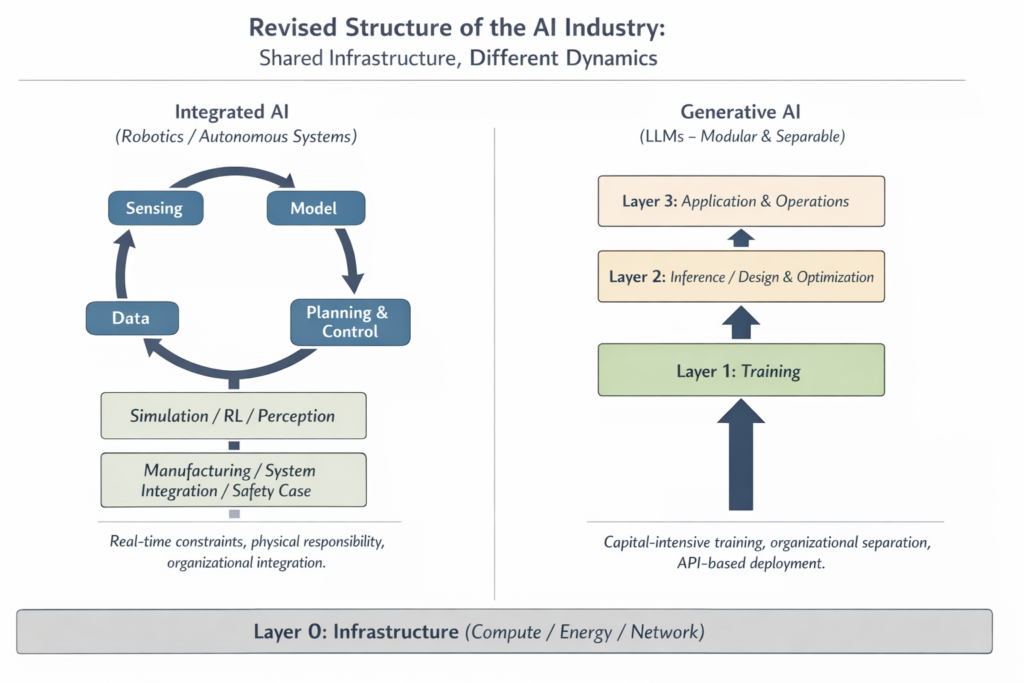
Figure 1. Revised Structure of the AI Industry: Shared Infrastructure, Different Dynamics.
The left panel illustrates integrated AI systems such as robotics, where sensing, control, and operation are tightly coupled. The right panel shows modular generative AI systems centered on large language models. Both structures rest on the same infrastructure layer.
Chapter 1: What Training Actually Means as an Industrial Process
Any attempt to discuss AI as an industry must begin with clarity about what training actually is.
Training is not simply the act of feeding large volumes of data into a model. At its core, training is a narrowly defined process with a precise causal structure. The difference between model output and ground truth is formalized as loss. That loss is transformed into gradients via backpropagation, and those gradients update the model’s internal weights.
To understand the training process is to be able to explain where error is defined, which parameters are affected, in what direction, and to what extent.
This definition introduces a clear boundary. No matter how sophisticated prompt engineering becomes, and no matter how elaborate retrieval-augmented systems are, if no error signal is written into the weights, the process is not training. Conversely, any operation that updates weights based on error belongs to the training process, regardless of scale or technique.
This framing deliberately treats training not as a methodological category, but as a manufacturing step. It is one stage in a production pipeline, characterized by the irreversible transformation of the product itself.
Chapter 2: Before Weights Are Updated: Data as a Production Constraint
Training, however, does not exist in isolation. It is constrained by conditions that precede weight updates.
Before a model can be trained, decisions must be made about which data can be used, at what granularity, and under what legal and ethical constraints. These decisions form part of the production environment rather than the algorithm itself.
Differences between European GDPR regimes, Chinese state-centered data governance, and privately owned platform data in the United States are often framed as ideological contrasts. From an industrial perspective, they are better understood as differences in production constraints—that is, supply chain conditions.
These constraints determine which linguistic, institutional, and social environments can be reliably incorporated into large-scale training. They do not dictate what a model “believes.” They determine what kinds of usage, explanation, and maintenance are feasible after deployment.
In this sense, data access functions as an upstream condition that spans infrastructure and training processes. It shapes the stability and repeatability of the manufacturing pipeline.
Chapter 3: AI as a Four-Process Industrial Structure
When AI is examined as a manufacturing system rather than a purely computational artifact, a four-process structure emerges naturally.
- Process 0: Infrastructure
This includes compute hardware, power supply, cooling, data centers, and networks. These components existed before modern AI but now function as upstream constraints on scale, speed, and feasibility. They are the factory floor. - Process 1: Model Generation and Weight Formation
This is the stage where internal model structure is created through error-based updates. It requires large capital investment and the capacity to absorb failure costs when training does not succeed. This is the Heavy Industry layer. - Process 2: Inference Design and Optimization
Here, trained models are adapted for use. Latency, context management, safety controls (alignment), and integration are engineered. The model’s capabilities are not changed, but its behavior is shaped. - Process 3: Social Implementation and Operation
This is where AI systems are embedded into business operations, institutions, and everyday use. Outputs become decisions, actions, or services that interact directly with society. This is the Interface of Liability.
This structure is not derived from responsibility debates. It follows directly from process separation. Responsibility becomes visible only after production stages are clearly distinguished.
Chapter 4: Responsibility and the Asymmetry of Failure
This discussion of responsibility is not intended as a normative critique. It is an engineering observation about how visibility and failure propagate through a segmented production pipeline.
Once processes are separated, we can see why accountability is so difficult to assign. It stems from a structural asymmetry in how failures manifest.
In traditional industries, a defect is visible on the product. In AI, failures look different depending on where they occur:
- Upstream Failure (Process 1):
If a model fails to train or performs poorly, it appears as a sunk cost or financial loss for the developer. It is an internalized corporate risk. - Downstream Failure (Process 3):
If a deployed model hallucinates, discriminates, or causes an accident, it appears as a scandal, a lawsuit, or physical harm. It becomes an externalized social event.
Failures are socialized downstream. This is why responsibility discussions often collapse into generalized blame toward the user or the operator (Process 3), while the upstream manufacturing process (Process 1) remains a “black box,” protected by its technical opacity.
This does not mean AI is uniquely irresponsible. It means its production pipeline distributes visibility unevenly. When process boundaries are unclear, responsibility appears arbitrary. When processes are understood, responsibility becomes a matter of engineering logic rather than moral debate.
Chapter 5: Why Nations Seek Their Own Models
This perspective also clarifies why governments express interest in domestic large language models.
The motivation is often described in terms of national values or ideological autonomy. In practice, it is more accurately explained as an operational concern.
A society needs systems that can be explained, regulated, audited, and corrected in its own legal and linguistic context. This requires models that have been trained, adapted, and tested within production constraints compatible with local institutions.
The objective is not to encode national ideology into weights. It is to ensure that downstream processes, especially deployment and operation, can function predictably and sustainably.
From this standpoint, maintaining some degree of domestic control over upstream processes is not nationalism. It is industrial risk management.
Conclusion
This essay does not argue that AI should be understood primarily as a question of responsibility. Rather, it argues that responsibility becomes meaningful only after production processes are properly distinguished.
What appears today as a debate about accountability is often a symptom of missing process literacy. When manufacturing stages are conflated, responsibility appears diffuse and politicized.
By contrast, when AI is understood as a layered production system, responsibility follows naturally from function.
Before asking who should be blamed, we must ask what was built, where, and how. Only then can discussions about governance, safety, and national strategy rest on solid ground.