
The Flight That Returned from Nowhere — Manifest and the Question of Solidarity
— Manifest. From the cultural currents of the 1960s to today’s search for meaning, can dreams turn into solidarities?
Manifest — From Dreams to Solidarity
Today in my English class, I brought up the Netflix drama Manifest. It has become quite popular: a plane caught in turbulence suddenly returns after five and a half years, yet none of the passengers have aged a single day. They are confronted with the fact that their families and friends have lived through those years without them. Some return to find that loved ones have built new households, or that their children have already grown up — painful realities that force them to face the gap in time.
The passengers also begin to experience mysterious voices and visions called “Callings” (rendered as 呼び掛け in the Japanese dub). In one scene, a woman suddenly hears the words “slow down,” slams on the brakes, and narrowly prevents a child from being hit by a car. On top of this, they must confront the ominous “Death Date,” a fateful deadline that drives the story forward.
The Echo of the 1960s
When I mentioned this curious title, my teacher Tony immediately spoke about something else: the growing popularity in America of “manifestation,” promoted by Dr. Joe Dispenza. It is the idea that human thought and consciousness shape physical reality. Hearing this, I felt a strange sense of déjà vu, recognizing in this individualistic pursuit of inner change an echo of the Human Potential Movement from my youth.
When I was young, I had often heard about the atmosphere on the American West Coast, where the Esalen Institute and many other communities were thriving. The so-called Human Potential Movement was in full bloom — yoga, meditation, Gestalt therapy, the reception of Eastern philosophies, and even experiments with LSD as a path to “expanded consciousness.” The lectures of Alan Watts, Maslow’s idea of “self-actualization,” and the spread of Transactional Analysis were often mentioned by those around me, and I felt that air indirectly, even from Japan.
At its core was the intuition that “if consciousness changes, the world changes.” Seeing American youth turn their suspicion toward authority and institutions, seeking love, peace, and freer communities — even from afar — softened my feelings of hostility toward those drafted into the Vietnam War. They, too, were suffering; solidarity was needed.
Shinjuku, Paris, and the Sound of Protest
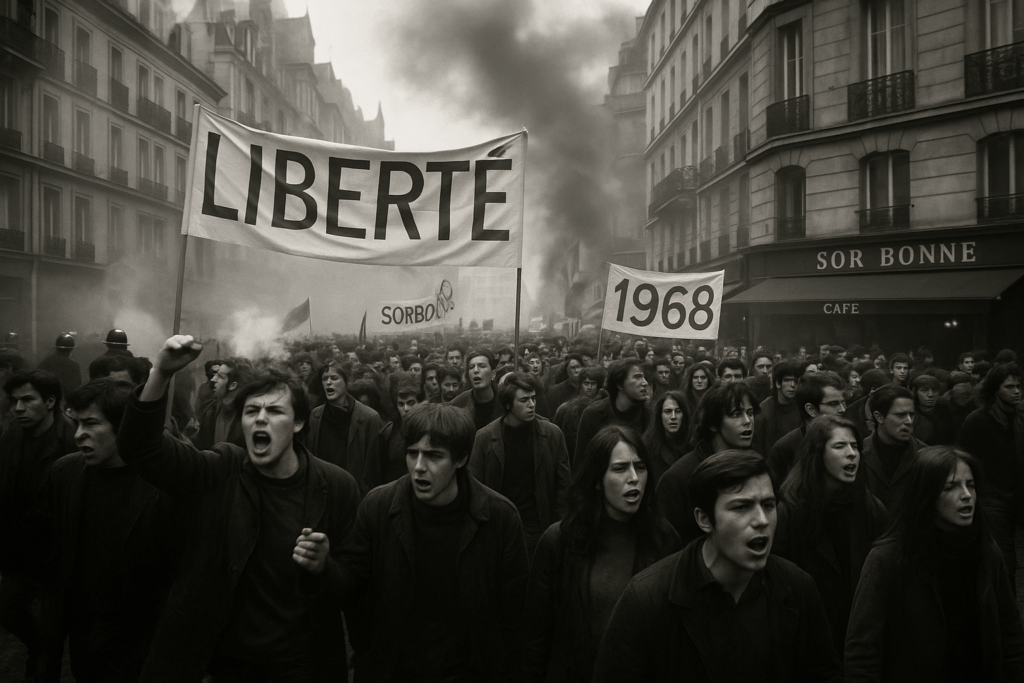
Ah !
Le joli mois de mai à Paris
“May 1968 — The Echo of the 1960s”
At the same time, Japan also saw a broad anti–Vietnam War movement. In Shinjuku, young people gathered in the so-called “folk guerrilla,” singing protest songs and handing out leaflets. Soon after came the Kanda Incident and the Shinjuku Riot, and the streets were filled with tension and fervor. I was in the midst of that swirl, and what struck me, even then, was how the contradictions of society seemed to ignite a shared energy of protest that transcended borders.
The year 1968 was one in which the same questions erupted worldwide: the May Revolution in Paris, the Prague Spring crushed by Soviet tanks, Japan’s university struggles, and the second wave of protests against the U.S.–Japan Security Treaty. There was no direct connection between us, and yet I cannot help but feel that the cobblestones of Paris and the pavements of Kanda were grappling with the same questions of authority and individual freedom. The West Coast, too, seemed part of that larger current, and Japanese youth, myself included, naturally felt a sense of solidarity with its air.
From the Age of Protest to the Age of Self
Half a century later, the claims of Joe Dispenza and others — “thought becomes reality,” “consciousness shapes the material world” are spreading widely. This time they come wrapped in scientific language, disseminated globally through YouTube and online courses. Yet to me, their roots lie unmistakably in the New Age culture of the 1960s.
Yet I cannot help but feel a concern. Spiritual quests in that earlier era, for all their decadence and despair, were almost always bound up with a yearning for solidarity and community. My own memories of resonance in Tokyo carry that same sense: protest against social contradictions, and the feeling of we.
By contrast, today’s manifestation seems to emphasize personal growth and individual healing, with little sign that it can generate collective solidarity. Personal awakening should not be dismissed, but by itself it cannot stand against social injustice and violence.
If, however, this trend were to expand beyond the self, as in Greta Thunberg’s environmental movement, it might indeed take the form of a new hope. Her message, after all, calls not merely for individual self-realization but for solidarity across generations and across the globe.
A Word That Still Asks a Question
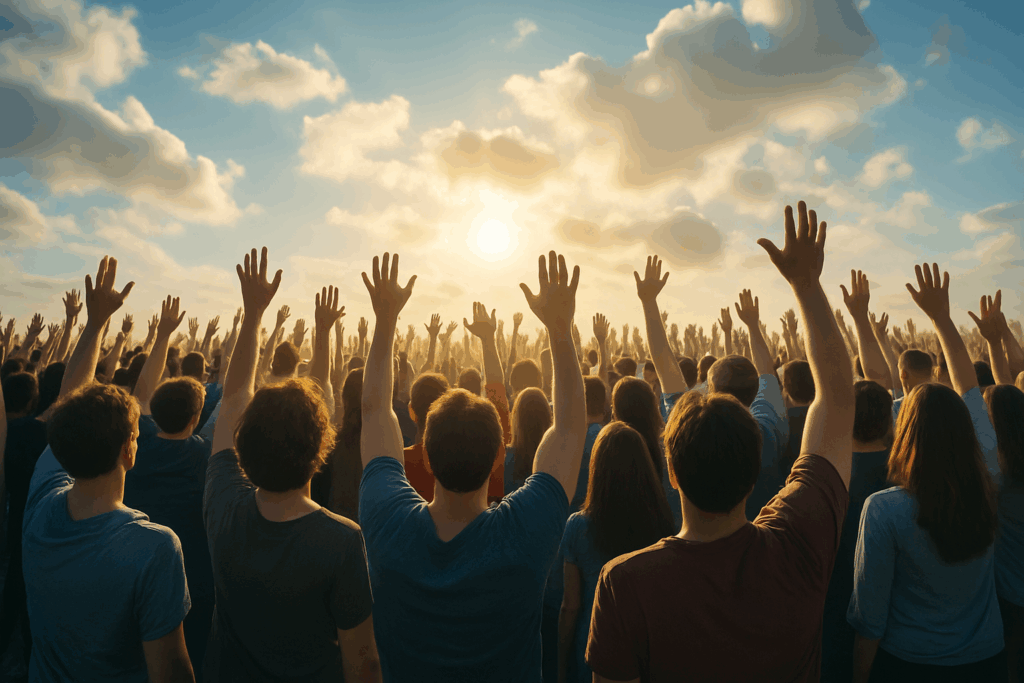
A question remains: can the hands of today shape the solidarities of tomorrow?
As we look around the world today, we see despair in Gaza, unending war in Ukraine, the rise of nationalism tearing at societies, and, in Japan, the growing strength of historical denialism. Against such realities, manifestation confined to inner healing risks remaining no more than temporary comfort.
Manifest, the word evokes declaration (manifesto), appearance (manifestation), and omen of destiny. But for me, the question remains a single one:
The answer is yet to be written — in our hands